Reading Sappho’s Leap, a novel by Erica Jong

Updated: Dec 15, 2025
“A book burrows into your life in a very profound way because the experience of reading is not passive.” —Erica Jong
I had stopped writing poetry for some time and had been focused on my fiction. Until I read Sappho’s Leap by Erica Jong. I was under fifty years old at the time.
Sappho was known as the mortal muse. She and Jong have been muses for me. My voice reawakened. I believe muses can be spiritual entities or energies that guide your hand as you write by guiding your soul to open up and be. It’s like that when the book writes itself, or a musician whose muscle memory is guided by a light, or an artist painting in a dazed delight, or a release of feelings while in dance. I also believe a muse can be a person who inspires you or can be someone you love. Sometimes, even, someone you hate—like little pieces of yourself.
Sappho was a writer whose works (from around 600 BCE) have been lost. However, the fragments (metaphors for love) have inspired many others, including Erica Jong. The prologue in Sappho’s Leap opens the story from the viewpoint of a witchy fifty-year-old woman, Sappho, as she writes about Aphrodite, love, youth and aging. She mentions her young love, Alcaeus, and her recent lover, a ferry boy named Phaon. She introduces that our story will begin when she is sixteen.
I took my time enjoying this first read—a little bit every morning. I have always been a very spiritual person. So, I felt even closer to the main character for that reason. I found every bit of the novel fascinating. Perhaps because I have a Greek heritage, perhaps because I have written many poems myself, perhaps because Erica Jong is an excellent writer. Most likely, all three. Halfway through, I looked her up and picked out a few more of her books to read.
Not only had this book inspired me to write poetry again, it also stimulated me to read poetry again. In my youth, Sylvia Plath was one of my favorites, so it’s no wonder I loved this so much (Jong compared Sappho to Plath in the Afterword). Jong added her own poetry at the end of the novel. These poems inspired me more after my second read of the novel, when I was over fifty.
Although, during my second read, I found parts of the story disturbing (because things in the world are disturbing), I enjoyed it just as much. I mostly enjoyed specific lines. Short quotes under fair use (e.g., under 10 – 25 words or a few lines) are usually fine for blogging, so I will share my favorites.
In our youth we have a unique intelligence, but the fool within burns it up like a blood sacrifice for something we do not want. Or maybe the world turns us into fools until we teach ourselves to conquer it. Or until we learn that love is not a fairytale, but it is wonderful. Perhaps this is the main reason I love these quotes so much. I’ll start with this one:
“Oh, I longed for my virginity now as if it were my native land!”
This quote speaks to middle-aged women, I’m sure—our memories of innocence, our regrets, our longing for young beauty, and the feelings of safety, familiarity and fearlessness some of us experienced when we were young. Which brings me to when Jong quotes Sappho:
Home—“Far more sweet-sounding than a lyre. More golden than gold.” —Sappho
Another favorite:
“When we make love we experience a foretaste of immortality.”
What a beautiful quote! It can mean many things to many people. It could hint at conceiving. It could be referring to the power of sex. Or, it could explain feeling like a god or goddess during the act, or a spiritual coupling.
Next:
“A singer needs freedom. So does a woman.”
I love this quote because I believe it to be true. Of course, Sappho was a singer and a woman in a time when women were sometimes treated like cattle—fathers marrying off their daughters to whomever they sought fit. But for me, it speaks of art and love, both of which need freedom to be true. In fact, this is essential to the story. Check out this excerpt:
“What was the answer here? A world where love was free or a world where love was chained? . . . Some people will turn freedom into slavery and others will turn slavery to freedom.”
Moving on. . . During an interesting scene in the middle of our novel, Sappho visits the Amazons and has a conversation with a young warrior woman. I like this excerpt because I found myself laughing out loud:
“He is a man and cannot be trusted. . .Unless they are castrated, their brains do not function properly. Fumes which rise from their testicles, blind their eyes and muddle their brains, poor things. They can’t help it.”
The following Jong quotes are concepts written with her verbal artistry, and I’ve turned them into images.

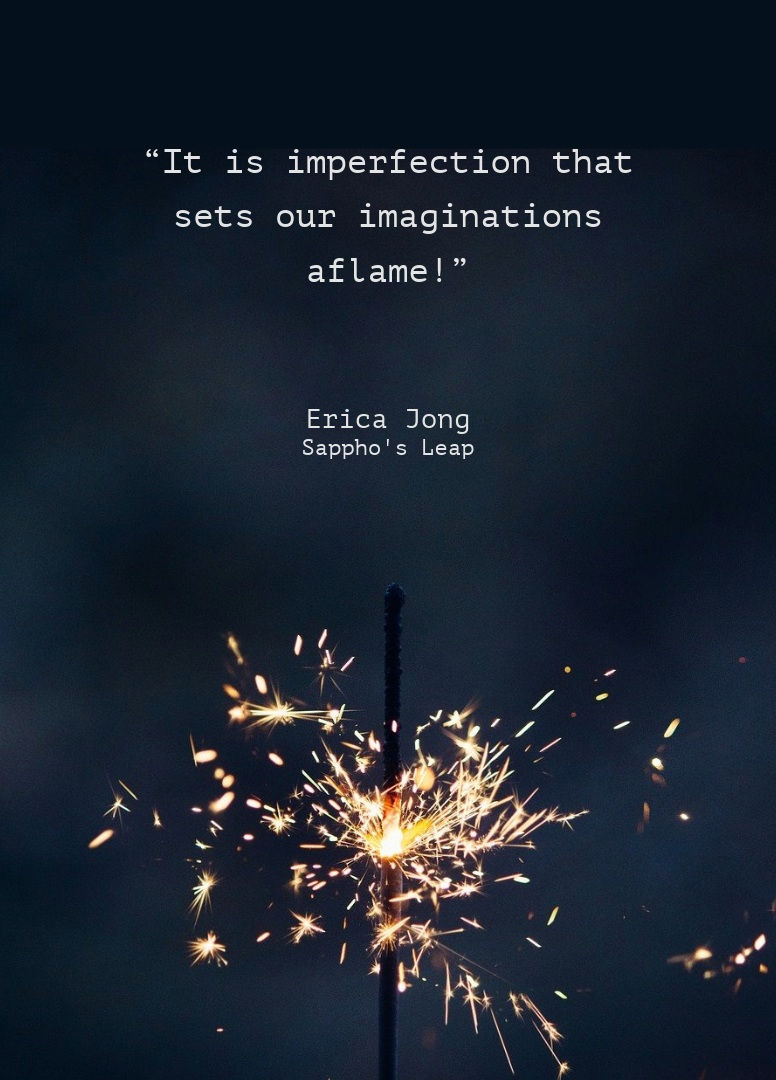


Our story takes place during polytheistic times. I found this quote interesting: “I always cringe at the phrase ‘the only truth.’ I know I am in the presence of zealotry.”
Ready for another funny one!
“You don’t think I would throw my whole life away for a lively prick! Once, when I was young. But now? Other things are far too important. And life goes on. It is not long, but it is long enough to see through the follies of men.”
Ladies, we can relate, right? At least with some men! What’s also true:
“Kindness is the highest wisdom.”
I’m all about love and art and spiritualism. This novel has all three. Let’s explore more quotes:
“Love is a sort of madness, as all singers know. It is a bitter madness that inspires sweet song!”
Let’s face it, most songs are written about love. And, love can be a madness, a loss of reason, an acid trip, a blinding strike to the heart like cupid’s arrow. Also, as I’ve said before, true love is divine—which isn’t quite madness but is supernatural in that it is godly, spiritual, magical and does, indeed, inspire creation. . . of arts such as songwriting.
“Love is not a fatal disease but a powerful lesson. It will never stop teaching you about yourself.”
Now we’re getting somewhere! Growing, learning, loving. We learn about ourselves from love by our actions and our changed actions. Also, we learn about ourselves by bringing the unconscious up to surface, which we can do with art. In fact, the story reflects this when Jong writes:
“Poems, like dreams, are a sort of wild road to the unconscious.”

“There was a divine plan, after all—but one I could only see looking back.”

“A singer must have something to sing about and the gods had given me a cornucopia of loves and adventures.”
I especially like this quote because it focuses on the positive. Another positive one:
“Songs keep you young. I suppose. Or perhaps it was love. Aphrodite had breathed her hot breath on my life and kept it warm!”
The final two of my favorites:


Reading Sappho's Leap twice has given me enjoyment, perspective, reflection, and inspiration.
Prophecy and poetry. Voracity and loves. Dive into the sea and the island and the island women with Jong’s descriptions. Ride the waves of her story, her song. Taste the secret spaces of Greek mythology.
If you love song, you will probably enjoy this dreamy novel. Politics aside, I am grateful to Erica for writing it.
Love,
Tracy

Reading Sappho's Leap, a novel by Erica Jong